

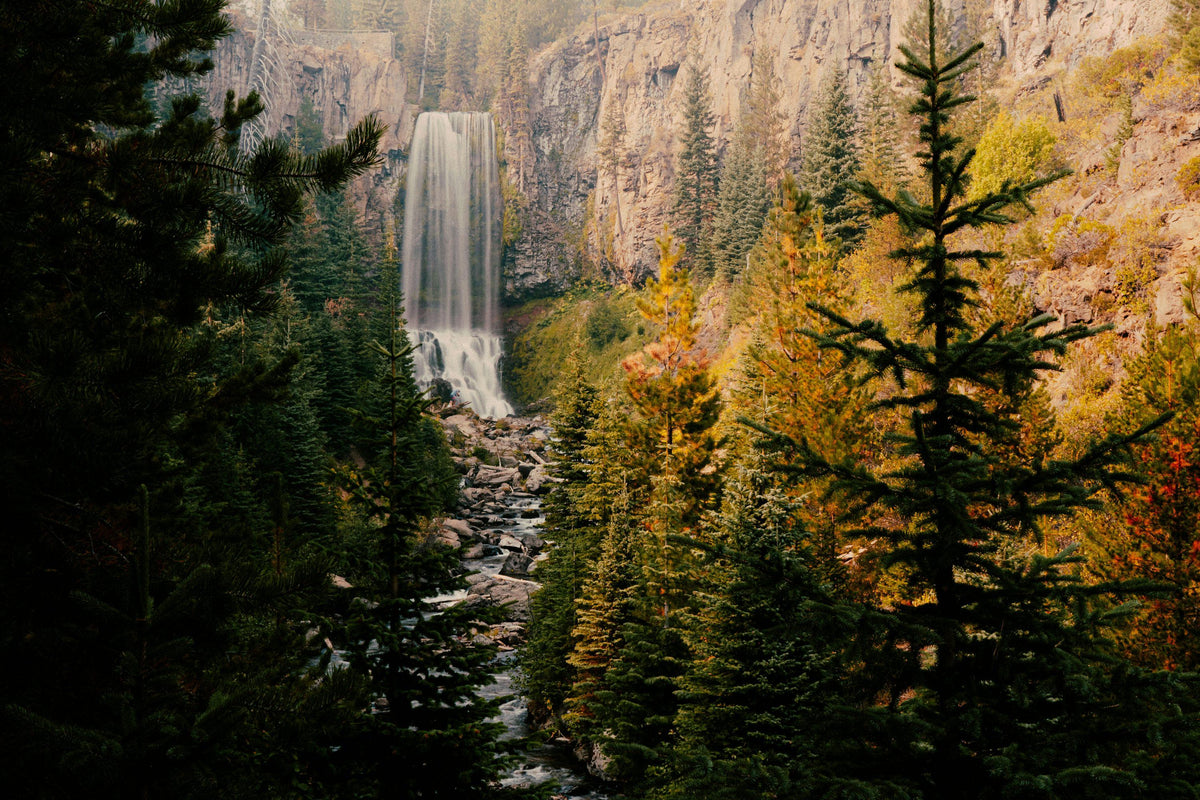
There’s something about hiking in the fall that just hits different.
The air is cooler, the summer crowds start to thin out, and the Pacific Northwest trades some of its usual green for gold, orange and deep red. And, arguably most important, hiking without sweating through your shirt five minutes in is a beautiful thing.
Whether you’re looking for an easy morning walk or a full-day adventure, we rounded up some of the best fall hikes in Oregon and Washington, with a little something for every kind of hiker.
Pack some layers, plenty of water, a Better Bar (obviously), and go see some leaves.
1. Wahclella Falls
Columbia River Gorge, Oregon
Difficulty: Easy
Distance: About 2.4 miles round trip
If you want maximum scenery for relatively minimal effort, Wahclella Falls is hard to beat.
The trail follows Tanner Creek through a narrow, mossy canyon before reaching the two-tiered waterfall. In fall, the surrounding vine maples and deciduous trees bring pops of red, orange and gold to an already ridiculously pretty landscape.
It’s short enough for a casual morning hike but scenic enough that it still feels like you went somewhere.
Best for: A quick fall adventure, newer hikers and waterfall people.
2. Benham Falls
Near Bend, Oregon
Difficulty: Easy
Distance: About 1.5 miles round trip from the east trailhead
This is a good one for anyone whose ideal hike is more “beautiful walk in the woods” and less “why did I agree to climb this mountain?”
The trail winds through ponderosa forest alongside the Deschutes River, with flashes of red, yellow and orange foliage before reaching views of the rushing water at Benham Falls.
It’s relatively flat, approachable and an easy addition to a fall weekend around Bend or Sunriver.
Best for: Families, casual hikers and pairing a hike with a weekend in Bend.
3. Misery Ridge at Smith Rock
Terrebonne, Oregon
Difficulty: Challenging
Distance: About 2.6 miles round trip for the main Misery Ridge route
Don’t let the name scare you off. Or maybe let it scare you a little.
Misery Ridge climbs steeply above the Crooked River, but the payoff is huge: towering rock formations, high-desert landscapes and expansive views toward the Cascades. Fall brings cooler temperatures that make the exposed climb considerably more enjoyable than tackling it under the summer sun.
If Misery Ridge sounds like a little too much misery, Smith Rock also has easier trails along the Crooked River with plenty of scenery and seasonal color.
Best for: Anyone who wants to earn their snack.
4. Tumalo Falls
Near Bend, Oregon
Difficulty: Easy to Moderate
Distance: Flexible
Tumalo Falls is one of those places where you can choose your own adventure.
You can take in the 97-foot waterfall near the trailhead or keep hiking along Tumalo Creek to find additional waterfalls, forest views and groves of aspen that turn bright yellow in the fall.
That flexibility makes this a great option for groups with different hiking abilities. Go for an hour or make a bigger day out of it.
Best for: Waterfalls, golden aspens and hikers who don't want to commit to a specific mileage.
5. Naches Peak Loop
Mount Rainier Area, Washington
Difficulty: Easy to Moderate
Distance: About 3.4 miles round trip
If you want a hike that looks like someone turned the saturation all the way up, put Naches Peak on the list.
The loop travels through subalpine scenery near Chinook Pass, where fall brings brilliant reds and oranges to the low-growing huckleberry and other alpine vegetation. On a clear day, you’ll also get postcard-worthy views of Mount Rainier.
At roughly 3.4 miles with around 600 feet of elevation gain, it packs a lot of scenery into a relatively approachable hike.
Best for: Big views without a big mileage day.
6. Blue Lake
North Cascades, Washington
Difficulty: Easy to Moderate
Distance: About 4.4 miles round trip
Welcome to larch season.
Unlike most conifers, larches actually change color and drop their needles. For a brief window each fall, they turn an almost unreal shade of gold — and the North Cascades are one of the best places to see them.
Blue Lake gives you that classic Washington fall experience without requiring a monster hike. The trail climbs toward an alpine lake surrounded by golden larches and the dramatic granite peaks of the Liberty Bell group.
Larch season is short, generally running from late September into October, so timing matters.
Best for: First-time larch chasers and photographers.
7. Heather-Maple Pass Loop
North Cascades, Washington
Difficulty: Moderate to Challenging
Distance: About 7.2 miles round trip
If Blue Lake is your introduction to larches, Maple Pass is the full experience.
The loop climbs through forest and alpine terrain before reaching sweeping ridgeline views over the North Cascades. Come fall, golden larches mix with red and orange alpine vegetation to create one of Washington’s most famous autumn landscapes.
It’s a bigger day than some of the hikes on this list, with roughly 2,000 feet of elevation gain, but the scenery is pretty relentless once you get into the high country.
Unsurprisingly, everyone else knows it's beautiful too. Expect crowds during peak larch season, especially on weekends.
Best for: Experienced hikers looking for the full PNW fall experience.
8. Skyline Trail
Mount Rainier National Park, Washington
Difficulty: Moderate to Challenging
Distance: About 5.5 miles round trip
The Skyline Trail is already one of the Pacific Northwest’s classic hikes, but fall gives it a completely different personality.
Starting from Paradise, the trail climbs through subalpine meadows toward Panorama Point, with close-up views of Mount Rainier and its glaciers along the way. In autumn, the meadows shift into shades of crimson, rust and gold.
At around 1,700 feet of elevation gain, you'll work for the view — but this is one of those hikes where stopping every five minutes to stare at the scenery conveniently doubles as catching your breath.
Best for: A bucket-list fall hiking day.
A few things before you go
Fall hiking in the Pacific Northwest comes with a little extra unpredictability. Days get shorter, temperatures can change quickly and snow can arrive surprisingly early at higher elevations.
Always check current trail, road and weather conditions before heading out, especially for hikes in the North Cascades and around Mount Rainier. Bring layers, the 10 Essentials and more food and water than you think you'll need.
And please leave the trail the way you found it. Stay on designated paths, pack out what you pack in and give wildlife plenty of space.
Snacks taste Better outside
Whether your version of a fall hike is a two-mile waterfall walk or spending all day chasing golden larches, a good trail snack is non-negotiable.
Better Bar is easy to toss in your backpack, doesn't take up precious space and is ready whenever the mid-hike hunger hits.
So grab a bar, grab your favorite layer and go enjoy the very short, very beautiful window when the Pacific Northwest decides to show off.
Share:
Greenwashing is everywhere.